
Why Interactive Games Work Insights from Education and iGaming
The way people learn, interact with, and enjoy digital material has changed a lot thanks to interactive games. Interactive experiences are popular in both the educational technology and entertainment businesses. For example, interactive whiteboard games are used in classes, and immersive stories can be found online. Figuring out why people are so interested in these games leads to lessons that can be used in both classrooms and digital gaming sites. Together, the psychological factors that keep players interested and the progress in display technologies make for interesting experiences that keep people's attention and encourage useful involvement in a wide range of settings.
How Interactive Games Can Help You Learn and Play iGaming
Interactive stimuli have a big effect on our brains because they demand active participation instead of idle consumption. Learners are much more engaged when they can move items around on an interactive smartboard or make decisions that have big effects in digital stories. Multiple parts of the brain are activated at the same time by this increased participation, which improves memory formation and emotional connection to the material. Research regularly shows that engaging events are much better at helping people remember things than passive learning methods.
The feedback systems in our brains are very important for keeping us interested in interactive games. Every choice, click, or actual action makes you think about what might happen next, which releases dopamine and gives you the drive to keep going. This method is used by educational interactive games to give students instant feedback on their actions, and it's also used by gaming platforms to keep players interested. Because they trigger this basic psychological reaction, interactive choice games are still popular across all age groups and settings, from elementary schools to high-tech leisure platforms.
Cognitive load theory helps to explain why well-designed engaging experiences are better for both learning and fun. When involvement is useful instead of just for looks, it lowers the cognitive load on unnecessary tasks while raising the cognitive load on necessary tasks. When people play interactive fiction games, for example, they think about story details more deeply because the choices they make directly affect how the story ends. In the same way, students who play interactive wall projector games connect with educational material through a variety of senses, which builds stronger neural pathways than a single mode of instruction would.

From Smartboard Games That You Can Interact With to Interactive Whiteboard Games
The change from simple whiteboards to advanced interactive smartboards is a big step forward in technology that has completely changed how classrooms work. Early interactive whiteboard games only supported simple touch controls and movements. Modern smartboard systems, on the other hand, can recognize multiple touches, gestures, and work seamlessly with educational software. This change is similar to a larger trend in human-computer interaction, where more advanced interfaces make it easier to connect with digital material in a natural and intuitive way.
Improvements in Technology for Interactive Educational Displays
Today's dynamic smartboards have both hardware and software features that work together to support a wide range of learning tasks. These systems keep track of multiple touch points at the same time, which lets multiple students work together to solve problems by interacting with material at the same time. The screens can read scribbling, turn it into text, and save notes in real time, so classroom talks can be seen again and again. Integration with cloud platforms gives teachers access to huge collections of interactive games and themes that can be changed to fit specific educational standards.
| Feature | Traditional Whiteboards | Modern Interactive Smartboards |
|---|---|---|
| Touch Input | Single or dual-touch | Multi-touch (10+ points) |
| Handwriting Recognition | Manual transcription | Automatic digital capture |
| Content Saving | Cloud-based recording | Cloud-based recording |
| Media Support | Limited multimedia integration for printed materials | Full video, audio, and web projection-based media |
| Collaboration | Sequential (one at a time) | Simultaneous (multiple users) depending on surface size |
| Software Integration | Without app libraries | With app libraries |

Metrics for Educational Outcomes and Engagement
Schools that use interactive smartboard games say that student interest and test scores go up in a measured way. These interfaces are especially helpful for kinesthetic learners who have trouble with standard lecture styles because they are touch-sensitive. Differentiating instruction is possible when teachers use interactive wall games that change the level of effort based on how students respond. This makes personalized learning routes within activities that the whole class does. The visible and physical feedback loop keeps students' attention longer than other ways of teaching.
"Interactive technologies transform classrooms from spaces where information is delivered to environments where knowledge is actively constructed through student-driven exploration and experimentation."
Interactive Projector and Wall Games That Are Fun to Look At
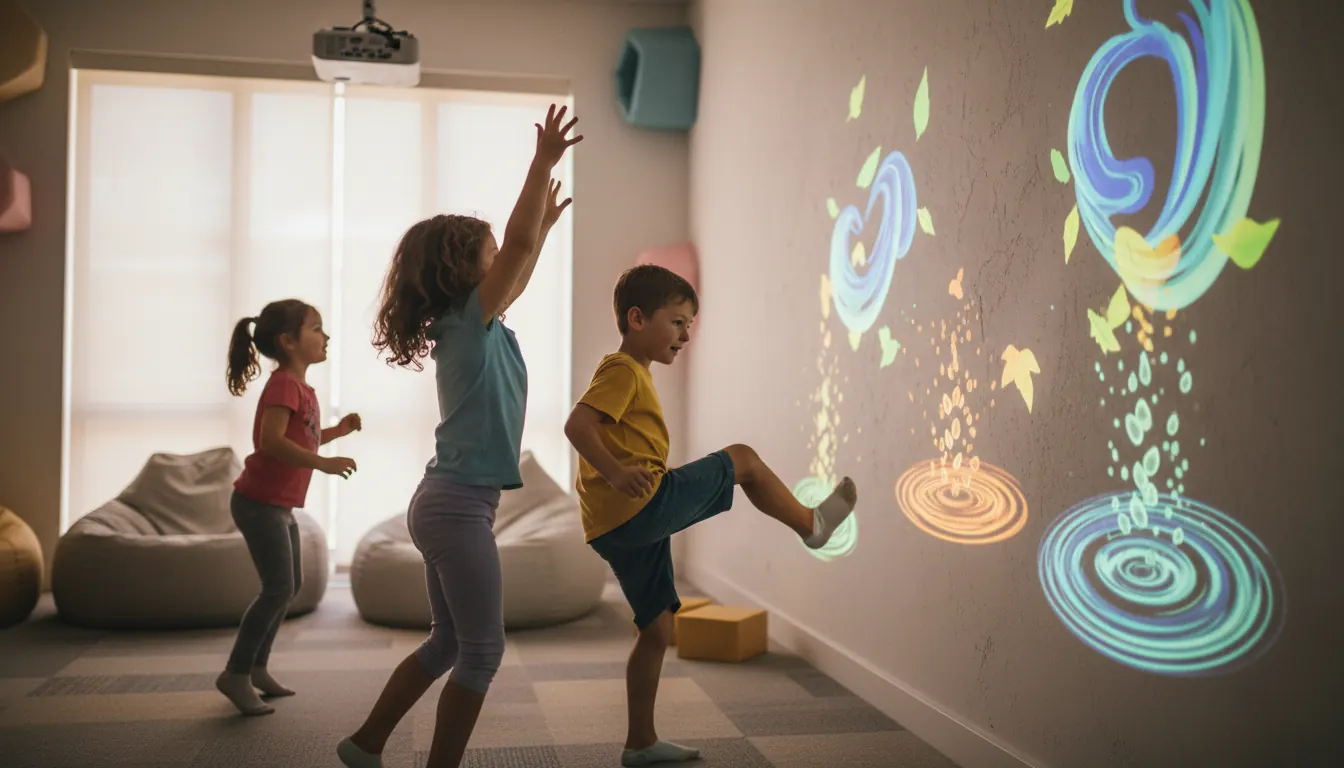
By turning everyday surfaces into responsive play areas, interactive projector games make settings that feel like they are really there. Instead of being limited to screens, these systems project interactive material onto floors or walls, letting you move your whole body and communicate with space. This physicality adds a layer that smaller screens can't match. This is especially helpful for helping young students improve their motor skills and making memorable experiences in public or business settings. Interactive wall projector games are popular because of their size and strangeness, which keeps players interested for long periods of time.
How to Make Projection-Based Interaction Work Technically
Infrared sensors, depth cameras, or computer vision techniques are used in modern interactive wall games to track how people move and touch the walls. As soon as someone touches or moves within the projection area, the system figures out their place and sends digital replies right away. This technology can be used in a lot of different creative ways, from math games where students physically step on the right answers to fitness activities that mix exercise with game-like tasks. Projector-based systems are very adaptable and can be used in almost any room with the right wall sizes.
Commercial entertainment places are adding interactive wall projector games more and more to make their shows stand out. Family activity centers use these displays to make attractions that are fun for people of all ages. Stores use them to get people to stay longer and interact with their brands. The casino industry has also realized the value of interactive experiences. For example, win zoria has added choice-based mechanics and interactive story elements to their games to make them more immersive and keep players playing longer than with traditional slot or table games.
Thoughts on Spatial Design for Maximum Impact
To make dynamic projector experiences that work well, you need to pay close attention to the lights, the projection angles, and where the users are sitting. Controlled lighting makes images clearer and sensors more accurate, and projectors that are placed on the roof keep shadows from moving users to a minimum. The interactive area needs to be clearly marked so people know where their actions will be recorded, and the content needs to be made so that it can be seen at normal viewing lengths in the installation space. These technology issues have a direct effect on how happy users are and on whether the interactive wall games meet their goals of getting people involved.
- Routines for calibration make sure that touch recognition works correctly on the whole projector surface.
- To avoid what seems like lag during encounters, content update rates must be higher than 30 frames per second.
- Audio feedback increases interest by letting people hear that their exchanges were good.
- Multiplayer features make socializing more fun and build shared experiences for everyone.
- Modular content design lets you make quick changes to keep things interesting and get people to come back.
- Safety zones keep players from running into walls or chairs while they're playing.
Choice Interactive Fiction Games and Stories Without Gambling
Interactive fiction games are a unique type of game because the story can go in different directions and the player can make their own choices, which makes each experience very different. These games don't tell stories in a straight line; instead, they let you make choices that affect the plot, the ties between characters, and the end result. The emotional interest that players feel comes from having a direct impact on what happens in the story. This sense of ownership is something that passive media viewing can't create. It's amazing how long this format has lasted, going from text-based tales to digital stories with lots of pictures, voice acting, and movie-like presentation.

How to Write Stories for Choice-Based Games
Effective interactive storytelling games strike a balance between the author's vision and the player's freedom, structuring stories so that decisions feel significant without building branching paths that are infinitely complicated. Authors use methods such as bottleneck events to bring together different plots again and state tracking to use choices made earlier in later parts of the story. This method gives the impression of a lot of story possibilities while still making creation possible. The most popular interactive fiction games don't have clear right-or-wrong choices. Instead, they have choices that reflect real moral problems or strategy trade-offs.
Narrative-focused interactive choice games are different from casino-style fun because they don't have gambling elements. However, both types of games use psychological connection in similar ways. To keep people interested, interactive fiction focuses on wonder and story investment, while gambling platforms use risk-reward expectation. Modern gaming platforms, on the other hand, mix these approaches more and more. For example, some casino games combine traditional betting mechanics with story elements and character progression to create hybrid entertainment formats that appeal to a wider range of people who want both story satisfaction and competitive excitement.
Factors Affecting Player Choice and Playability
Interactive stories games last a long time because you can play them over and over again to find new storylines. Players go back to explore paths that haven't been taken before, looking for different endings and hidden content that can only be reached through certain choice patterns. This ability to play again and again turns a single buy into dozens of hours of fun, which is why story-driven interactive experiences can be sold. This exploration is made official by achievement systems and success rates, which add metagame goals that go beyond the main story.
- Branching speech systems make it look like people are actually talking to each other while also leading players to important plot points.
- Character link meters show how the choices made by the player affect how NPCs act and the story options that are offered.
- Timed decision moments raise the stakes by pushing players to make a choice without giving it much thought.
- In morality systems, decisions are grouped by how virtuous they are, which affects how characters grow and change.
- Hidden factors track how small choices have small effects that add up to big effects later on.
- New "Game Plus" modes reward success by letting you access extra content or different points of view.
- Sharing choice results with the community starts a conversation about the best or most interesting ways to make a decision.
"The power of interactive narratives lies not in presenting the perfect story, but in making each player feel their journey through the narrative is uniquely theirs, shaped by decisions that reflect their values and priorities."
Presentations and Digital Platforms Can Use Interactive Games
There are more and more professional settings that use interactive games for presentations as ways to get people involved and turn them from passive viewers to active players. Quizzes, polls, and group problem-solving exercises are used in business meetings, academic conferences, and training events to keep people interested and reinforce important messages. This change comes from realizing that adults, like kids, remember things better when they do something with the material instead of just watching it. There are many crowd response platforms that can be used on smartphones, which has made adding interactive parts to presentations easy and cheap.

How to Choose a Platform and Put It Into Action
Picking the right interactive games for presentations relies on the size of the crowd, the technology available, and the goals of the show. In a small group setting, touchscreen screens let people directly change visual data; in a big hall, however, smartphone-based systems let people's answers add up to create group images. The interactive parts shouldn't take away from the main content; instead, they should add to it and serve as occasional engagement peaks that help people pay attention during longer sessions. For adoption to go smoothly, technology needs to be tested ahead of time, and backup plans need to be made in case of technical problems.
| Platform Type | Best Use Case | Audience Size | Technical Requirements | Engagement Level |
|---|---|---|---|---|
| Web-based polling | Quick feedback | 10–1000+ users | Smartphone penetration | Moderate |
| Touchscreen quizzes | Detailed learning | 5–30 users | Interactive display | High |
| Mobile app games | Gamified training | 20–500 users | App installation | Very high |
| VR simulations | Immersive skill practice | 1–10 users | VR headsets | Very high |
How to Measure Success and Learning Outcomes
To figure out how interactive games for presentations impact people, clear success metrics must be set up before the games are used. Follow-up tests let organizers keep track of how many people participated, how well they answered, how long it took to finish activities, and how much people remembered after the talk. By comparing these measures to standard data from talks that aren't interactive, we can see if the extra complexity leads to real benefits. Qualitative feedback from polls gives you more information about how participants felt, like which interactive parts kept them interested and which ones seemed like gimmicks or got in the way of the content.
Professional training teams at companies have been the first to use advanced analytics to track each person's progress through multi-session programs and find knowledge gaps that need more work. These systems make student profiles that change the content that is shown to them next based on how well they've already done with it. This makes the learning experience more personalized for everyone. The information that is collected lets training materials keep getting better by gradually making engaging parts better based on real-world proof of what changes employees' behavior and knowledge in different ways.
Conclusion
Interactive games work well for both learning and fun because they use basic human psychology to turn people who are just watching into active players. The main idea stays the same whether you use interactive whiteboard games in the classroom, immersive interactive wall projector experiences, story-driven interactive fiction games, or professional interactive games for presentations: people are more engaged when they can change the outcomes by the choices and actions they make. As technology keeps getting better, the line between learning and fun will become even less clear. This will lead to mixed experiences that teach while they entertain and entertain while they teach.
Frequently Asked Questions
What are the main benefits of using interactive whiteboard games in education?
Interactive whiteboard games provide multiple educational benefits including increased student engagement, better retention of information through multi-sensory learning, and the ability to accommodate different learning styles, especially kinesthetic learners. These systems allow for real-time collaboration, instant feedback, and personalized learning experiences that adapt to individual student responses. The touch-sensitive nature and visual feedback loop keep students' attention longer than traditional teaching methods.
How do interactive wall projector games differ from traditional screen-based games?
Interactive wall projector games transform ordinary surfaces like floors and walls into responsive play areas, allowing for full-body movement and spatial interaction that smaller screens cannot provide. These systems use infrared sensors, depth cameras, or computer vision to track user movements and provide immediate digital responses. This physicality is particularly beneficial for developing motor skills in young learners and creating memorable experiences in both educational and commercial entertainment settings.
What makes interactive fiction games engaging for players?
Interactive fiction games engage players by offering branching narratives where choices directly affect plot outcomes, character relationships, and endings. This creates a sense of ownership and emotional investment that passive media cannot replicate. The replayability factor allows players to explore different storylines and discover hidden content, while mechanics like character relationship meters, morality systems, and timed decisions add depth and consequence to player choices.
How can interactive games be effectively used in professional presentations?
Interactive games for presentations transform passive audiences into active participants through quizzes, polls, and group problem-solving exercises. The key to effectiveness is choosing the right platform based on audience size and goals, testing technology beforehand, and using interactive elements as engagement peaks rather than distractions. Success can be measured through participation rates, response accuracy, completion times, and post-presentation retention assessments compared to non-interactive presentations.
What psychological principles make interactive games effective for learning?
Interactive games leverage several psychological principles including active participation that activates multiple brain regions simultaneously, dopamine-driven feedback systems that motivate continued engagement, and cognitive load theory that focuses mental resources on meaningful tasks. The combination of immediate feedback, choice-consequence relationships, and multi-sensory engagement creates stronger neural pathways and better memory formation compared to passive learning methods.